
Modified Bitumen and Built-Up Roofing in Champaign, IL
Older brick buildings downtown, on campus and on Main Street often sit under asphalt-based roofs: tar-and-gravel built-up roofs or modified bitumen. Elite Champaign Commercial Roofers is a free quote service, not a contractor: describe your roof and independent, Illinois-licensed commercial roofing contractors can reply with quotes.
Get Free Quotes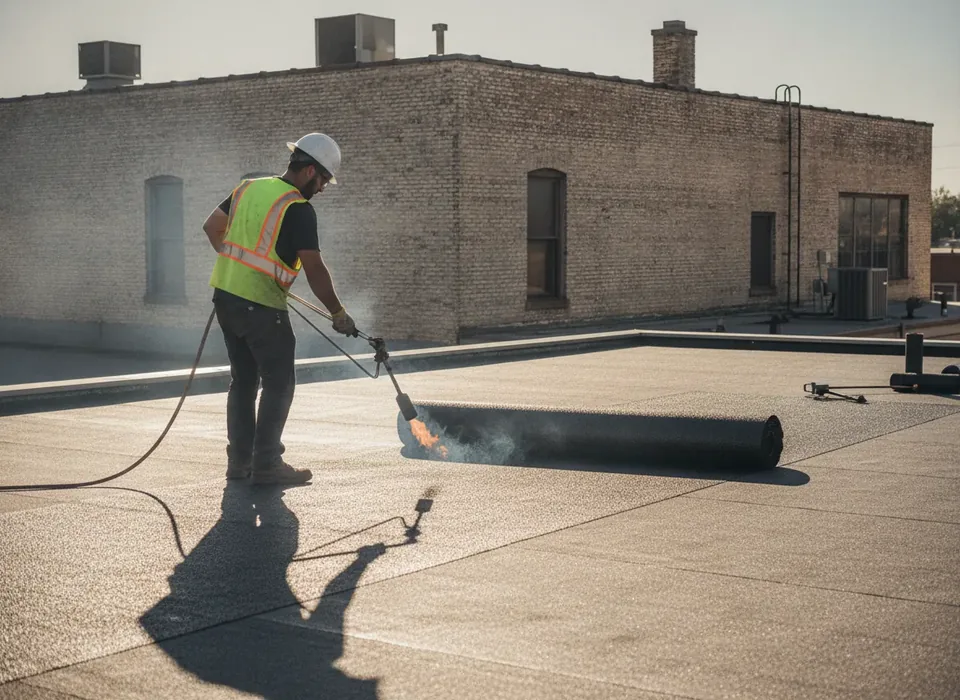
Two related systems
Built-up roofing (BUR) is the original flat roof: alternating layers of asphalt or coal tar and reinforcing felts, usually topped with gravel. Multiple plies give redundancy; a single cut does not always cause a leak.
Modified bitumen (mod bit) is the newer cousin: factory-made asphalt sheets modified with polymers (SBS or APP), installed in two or three plies with a granulated cap sheet. Sheets go down by:
- Torch-applied heat, common and fast but a fire-safety concern near wood and parapets
- Cold-applied adhesive
- Self-adhered sheets, often used where open flame is a problem
- Hot-mopped asphalt, the traditional BUR method
These systems fit buildings with lots of foot traffic, older masonry with parapets, and owners who want multiple layers of protection. Call Call (727) 300-6656 with questions.
Why these roofs are common in Champaign-Urbana
Downtown Champaign, Campustown and downtown Urbana hold many older masonry buildings with flat roofs, parapets and through-wall scuppers. That building stock has worn BUR and mod bit for decades. The University of Illinois reports that more than one-fifth of its academic facilities are 75 years old or older. Older private buildings around campus have a similar mix of original decks, several generations of roofing and patched parapets.
Those buildings bring specific roofing problems:
- Hidden layers. Older buildings may already have a roof over a roof. Core cuts tell you whether a recover is still allowed.
- Parapets and copings. Masonry walls crack and let water in behind flashing. Some "roof leaks" are wall leaks.
- Drainage. Interior drains in old buildings clog and sit at high points after decks sag, causing ponding.
- Fire risk during work. Torch-applied mod bit near wood nailers, old cants and parapet cavities needs careful fire-watch practice. Ask about it.
How mod bit and BUR roofs fail in this climate
Asphalt roofs age by drying out. Sun and heat drive off the oils that keep them flexible, and then freeze-thaw cycles do the rest. The Champaign station averages roughly 126 days a year at or below freezing, per state climatologist normals. Water that gets into a crack freezes and widens it. Typical symptoms:
- Alligatoring: a network of surface cracks on exposed asphalt
- Blisters: trapped moisture or air between plies that swells in heat
- Split felts: long straight cracks where the deck or insulation moved
- Bare spots: gravel washed or blown away, exposing asphalt to sun
- Granule loss: on mod bit cap sheets, especially after hail
- Open laps and failed flashing at parapets, curbs and drains
Hail bruises asphalt-based roofs in a way that often can't be seen from the ground. Urbana averages about 2.2 hail days a year. See the storm and hail damage page for what to do after a storm.
How contractors approach an old asphalt roof
Count the layers
Core cuts show how many roofs are on the deck and whether the insulation is dry. Two or more existing coverings rules out a recover under the 2021 IBC.
Map the moisture
On larger roofs, a moisture survey shows which areas are wet. Wet sections come out; dry sections may be kept under a recover.
Price the options
Spot repairs, a mod bit cap sheet over a sound base, a coating, or a full tear-off.
Plan the details
Parapets, copings, scuppers and drains decide whether the new roof works. On a tear-off, the energy code may also require an insulation upgrade.
Repairs on these systems need compatible materials. Coal-tar pitch and asphalt don't always bond well together, so ask what the existing roof is before approving a patch.
Modified bitumen and BUR cost
| System / item | Typical installed range | Source |
|---|---|---|
| Modified bitumen | $4–$8 / sq ft | Fixr 2026; ServiceTitan 2026 |
| Built-up (BUR) | $4–$12 / sq ft | Fixr 2026; ServiceTitan 2026 |
| Tear-off / removal (adder) | $1–$5 / sq ft | Fixr 2026 |
Typical lifespans (Fixr 2026): modified bitumen about 20 years, built-up 15–30 years. Gravel removal and disposal, deck repair on old buildings, energy-code insulation and parapet work can each add significantly. Compare totals with the cost calculator.
When to stay with asphalt, and when to switch
Stay with mod bit or BUR when the roof sees heavy foot traffic, when the building's details are built around asphalt flashings, or when a sound base can take a new cap sheet. Consider switching to TPO or PVC or EPDM when the roof is coming off anyway, when you want a reflective surface, or when roof weight is a concern on an older structure.
Questions to ask bidders
- How many layers did your core cuts find, and is the existing roof coal tar or asphalt?
- Torch, cold-applied or self-adhered, and what is your fire-watch practice for torch work?
- What will you do at the parapets and copings?
- How will you handle the gravel?
- What warranty applies, and who backs it?
- What is your Illinois unlimited roofing license number? Verify at idfpr.illinois.gov.
Mod bit and built-up roofing FAQ
What is the difference between modified bitumen and built-up roofing?
Built-up roofing is made on the roof from alternating layers of hot asphalt or coal tar and felts, usually topped with gravel. Modified bitumen uses factory-made polymer-modified asphalt sheets installed in two or three plies with a granulated cap. Both are multi-ply asphalt systems.
How much does a modified bitumen roof cost?
Typical national installed ranges are about $4 to $8 per square foot for modified bitumen and $4 to $12 for built-up roofing (Fixr 2026; ServiceTitan 2026). Tear-off, gravel removal, deck repair and insulation upgrades add cost. Champaign bids vary, so get local quotes.
Can a tar-and-gravel roof be recovered?
Sometimes. The gravel must be removed and the surface prepared, and code does not allow a recover if the roof already has two or more coverings or is water-soaked. Many older buildings have had a roof over a roof already, so core cuts are the first step.
Is torch-applied roofing safe on an older building?
It can be done safely, but older buildings with wood nailers, cants and hollow parapets carry fire risk. Ask bidders about their fire-watch practice after torch work and whether a cold-applied or self-adhered sheet would suit your building's details better.
Get free mod bit or built-up roofing quotes
Tell us the building type, roughly how old the roof is and whether it has gravel. Independent contractors can reply with no-obligation quotes.
Need a commercial roof looked at? Get free quotes.
Describe the building once and independent, Illinois-licensed commercial roofing contractors can reply with no-obligation quotes.