
Commercial Roof Maintenance Checklist: Spring, Fall and After Storms
Most commercial roof failures are slow. A clogged drain, a split in a flashing corner or a loose piece of edge metal sits for a season or two, then shows up as a ceiling stain over a server room or a stack of ruined inventory. A simple routine catches most of it early. This checklist is written for facility managers, property managers and boards responsible for a low-slope roof in East Central Illinois.
Elite Champaign Commercial Roofers is a free quote service. We connect building owners with independent, Illinois-licensed commercial roofing contractors for inspections, maintenance plans, repairs and replacement. The checklist below is what to ask for and what to keep on file.
How often should a commercial roof be inspected?
The common recommendation from commercial roofers is twice a year, in spring and fall, plus after any major storm. In Champaign-Urbana the timing lines up with the weather:
- Spring: after the last hard freezes, around or after the average last frost of April 15, to find winter damage before the severe-storm season.
- Fall: after most leaves are down and before the average first frost of October 17, so drains are clear and repairs can be done before winter.
- After storms: any event with large hail or strong wind. The August 2020 derecho brought 60–62 mph gusts to Champaign and Urbana, and the March 2025 storms measured 68 mph at Willard Airport.
The area averages about 23 inches of snow a year and more than 120 days a year at or below freezing (Illinois State Climatologist). Repeated freezing and thawing opens seams, flashing laps and cracks, and meltwater refreezes in blocked drains, which is why the fall visit matters so much.
Safety first
Roof access should be limited to trained people with proper fall protection, especially near edges, skylights and roof hatches. Facility staff can do many of the walk-around and interior checks below; leave anything on the roof surface beyond a quick look to a roofing contractor.
Spring checklist
- Walk the interior first: top-floor ceilings, stairwells, around skylights and below rooftop units. Note and photograph every stain.
- Clear drains, strainers, scuppers, gutters and downspouts of winter debris.
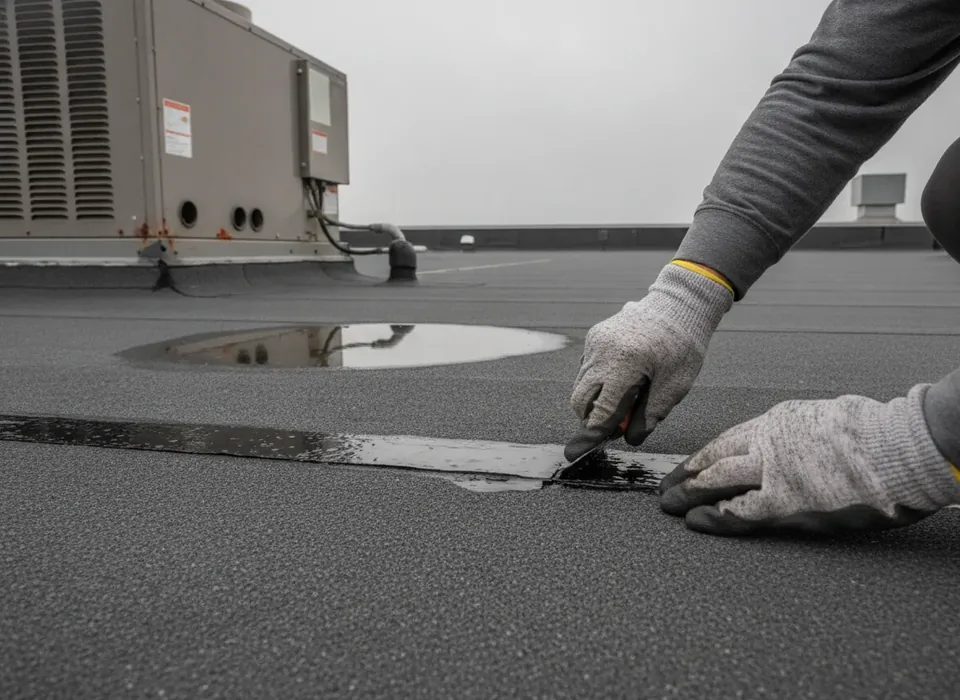
- Check the field of the roof for splits, punctures, blisters and open seams.
- Inspect flashings at parapets, walls, curbs and penetrations for separations or cracks from freeze-thaw.
- Look for loose or missing coping and edge metal.
- Check for ponding 48 hours after a rain. NRCA treats water still standing after 48 hours as ponding.
- Confirm sealant at pitch pans and penetrations is intact.
- Review any winter snow or ice removal for damage from shovels or equipment.
Fall checklist
- Clear leaves and debris from drains, scuppers and gutters, and plan another clearing after the last leaves drop if trees are nearby.
- Repair any open seams, flashing gaps or punctures before freezing weather.
- Check rooftop equipment panels and curbs. HVAC service crews often leave loose screws, panels and debris that puncture membranes.
- Make sure overflow drains and scuppers are unobstructed for winter melt.
- Inspect skylights and hatches for cracked domes and failed gaskets.
- Look at parapet caps and masonry for open joints that let water behind the flashing.
- Note heavy equipment or new penetrations added since spring.
After a storm
Check inside first
Look for new leaks, wet ceiling tiles and water near electrical equipment. Move inventory and equipment out of the way.
Look from the ground
Check for displaced edge metal, peeled membrane at corners, debris on the roof, and damaged rooftop units or skylights.
Document
Take dated photos of everything you can see safely, and note the date and time of the storm.
Call for an inspection
Hail damage is often invisible from the ground. A commercial roofer can inspect and write up findings. If you are filing a claim, see the hail and wind insurance guide.
Keep a roof file
Records turn a vague roof into a manageable asset. They also help with warranty questions and insurance claims, since many manufacturer warranties expect reasonable maintenance and prompt notice of problems. A simple log works:
| Record | What to keep |
|---|---|
| Roof basics | Square footage, system type, installation year, installer, drawings or core-cut results |
| Warranty | Manufacturer and workmanship warranty documents, terms and notice requirements |
| Inspections | Date, who inspected, findings, dated photos |
| Repairs | Date, location on a roof plan, what was done, cost, contractor |
| Leaks | Date, interior location, weather at the time, what was found |
| Rooftop work by others | HVAC, solar or telecom crews on the roof, and any new penetrations |
Budgeting for maintenance and replacement
A maintenance plan keeps repair costs small and predictable, and it tells you when to start saving for replacement. Inspection fees vary; some contractors offer free roof assessments. For small repairs, Fixr lists flat roof leak repairs at roughly $300–$1,250, with a typical figure around $750, as a national range.
For capital planning, start with expected service life. Typical lifespans (Fixr 2026):
| System | Typical lifespan | Typical installed range |
|---|---|---|
| TPO | 20–30 years | $4–$14 / sq ft |
| EPDM | Up to 30 years | $3–$13 / sq ft |
| Modified bitumen | About 20 years | $4–$8 / sq ft |
| Built-up (BUR) | 15–30 years | $4–$12 / sq ft |
| Metal | 50–70 years | $7–$15 / sq ft |
Price ranges are typical national installed ranges (Fixr Jan 2026, ServiceTitan Feb 2026). Champaign bids vary, so get local quotes. As a rough example, a 20,000 sq ft TPO replacement at those national figures falls somewhere between $80,000 and $280,000 before tear-off, insulation upgrades and access costs. That spread is why boards and owners benefit from a real proposal several years before the roof is due, so reserves can be planned instead of scrambled. The commercial roofing cost guide has a calculator, and the energy code guide explains why a replacement often costs more than the membrane alone.
What to ask for in a maintenance plan
- Scheduled spring and fall inspections with a written report and photos
- Drain and debris clearing included or priced per visit
- Minor repairs at a pre-agreed rate, with approval required above a set amount
- A roof plan marking repairs over time
- An estimate of remaining service life and a budget range for replacement
- How emergency leak calls are handled. Contractors often offer emergency response; ask about it.
- Confirmation of an Illinois unlimited roofing license (104- number) and current insurance
The roof inspections and maintenance page covers how contractors set up these plans. If a leak has already started, finding a flat roof leak and commercial roof repair are the next stops. To get maintenance or repair quotes, describe the building once on the free quote form.
Questions people ask
How often should a commercial roof be inspected?
Twice a year, in spring and fall, plus after major storms with large hail or strong wind. In Champaign-Urbana, a spring visit after the last hard freezes and a fall visit after leaf drop and before winter cover the biggest risks.
What should a commercial roof maintenance plan include?
Scheduled inspections with written reports and photos, drain and debris clearing, minor repairs at agreed rates, a roof plan tracking repairs, an estimate of remaining life with a replacement budget range, and clear terms for emergency leak calls.
Can facility staff do roof maintenance themselves?
Staff can handle interior checks, ground-level looks and record keeping. Work on the roof surface should be limited to trained people with fall protection. Many owners have a commercial roofing contractor handle the roof-level inspection and repairs.
How do I budget for a commercial roof replacement?
Start with the roof's age and expected lifespan, then get a real proposal a few years before it is due. National ranges such as $4 to $14 per square foot for TPO are wide, and tear-off, insulation and access costs add more.